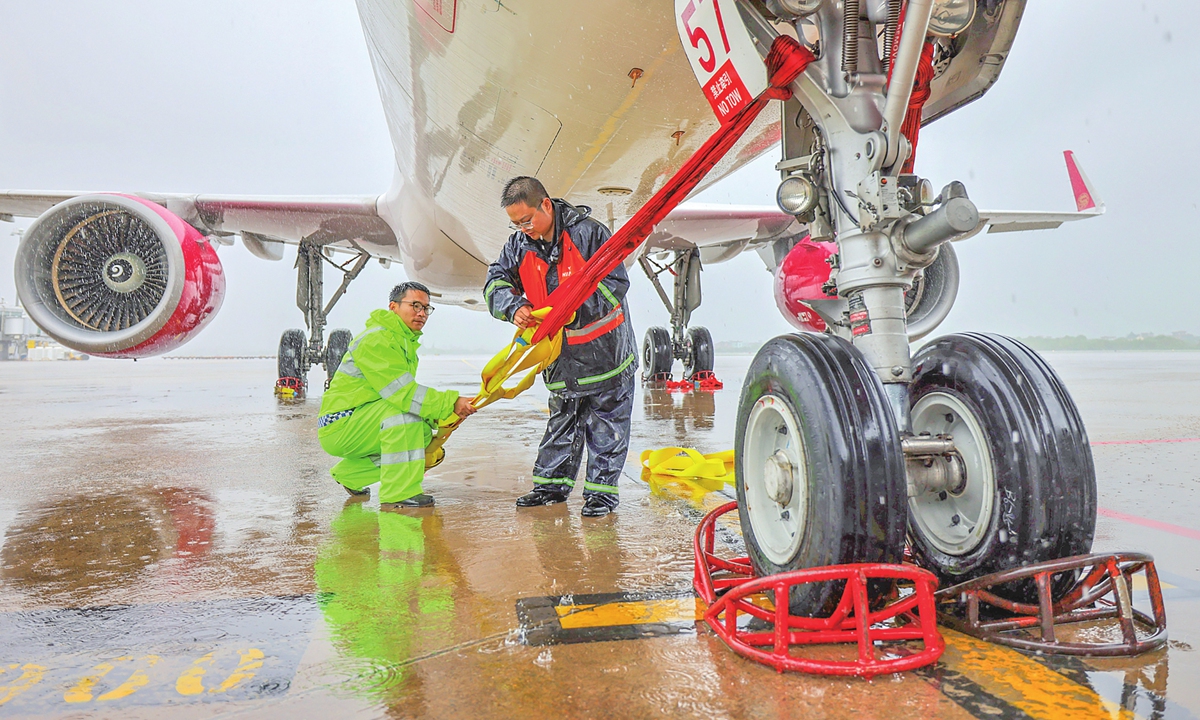
Staff members secure aircraft at Hangzhou Xiaoshan International Airport to prepare for Typhoon Dolphin on August 9, 2026. Photo: VCG
Typhoon Dolphin made landfall in Taizhou, East China's Zhejiang Province, on Sunday afternoon, bringing strong winds up to 42 meters per second and heavy torrential rain to the coastal regions amid a red alert - the highest level in the country's typhoon warning system - issued for it earlier that day.
Authorities in East China's Fujian have relocated nearly 100,000 residents, while coastal provinces are suspending railway services and canceled flights, making an all-out effort to mitigate possible risks.
The NMC maintained orange rainstorm and blue severe convective weather alerts at 6 am on Sunday, forecasting exceptionally heavy rainfall of 250 to 440 millimeters in some areas along the eastern coast of Zhejiang, with heavy to torrential rains expected across Jiangsu, Zhejiang, Shanghai, and Anhui between Sunday morning and Monday morning, China Central Television (CCTV) reported.
In response to the typhoon, China's meteorological authority on Sunday upgraded its emergency response for severe meteorological disasters from Level III to Level II.
Fujian raised the emergency response level for typhoon prevention to Level II at 9 am on Sunday.
As Typhoon Dolphin gathers strength and approaches the coastal areas, Fujian's flood control authority, as of 6 pm on Saturday, deployed a total of 17,800 officials to and relocated 98,900 people from high-risk areas, Xinhua News Agency reported on Saturday.
Fujian has suspended all 115 marine engineering projects and moved 290 construction vessels to safe waters, while 55 passenger ferry routes in affected waters have been halted, chinanews.com reported.
Meanwhile, railway services in the affected regions including Fujian, Zhejiang, Shanghai have also been suspended from Sunday to Monday, according to chinanews.com.
Fujian authorities have urged stronger safety measures for returning vessels, offshore platforms and coastal and island tourism, as well as reinforcement of aquaculture facilities. They also called for timely evacuations from flood- and landslide-prone areas to guard against secondary disasters from the typhoon and heavy rain, chinanews.com reported.
In Zhejiang, Wenzhou city has closed all 85 A-level national tourist attractions, turned away more than 7,400 visitors and evacuated over 1,600, with the relocation effort ongoing, according to CCTV. Next, Wenzhou will next implement a "five suspensions" policy, halting outdoor group activities, classes, work, business operations and transportation.
All fishing vessels at Shitang Fishing Port in Wenling, Zhejiang, have returned to port, with all personnel evacuated ashore and maritime rescue teams on standby. Authorities urged vessels to stay off the sea during the typhoon.
In Shanghai, Pudong and Hongqiao airports operated at reduced capacity on Sunday, with nearly 60 percent of flights canceled. A total of 1,384 flights are scheduled to be canceled including 871 at Pudong and 513 at Hongqiao. Passengers are advised to check with their airlines for the latest updates and adjust travel plans accordingly, according to CCTV.
According to Hu Xiao, meteorological analyst at the NMC, the typhoon has several notable features, including its strong intensity and expansive circulation. The typhoon also has several unusual features. Forming unusually far east, near 180°E, it has traveled more than 7,200 kilometers, making its potential landfall in China a rare event and possibly the easternmost such landfall since 1951. Its 12-day lifespan is also well above the typical seven-to-10-day average, CCTV reported.
According to Ma Jun, director of the Institute of Public and Environmental Affairs, Typhoon Dolphin traveled a long distance and remained at typhoon or severe typhoon strength of its lifespan so far. Despite passing through some areas that were unfavorable to its development, its powerful inner core remained intact, while its extensive cloud system continued to absorb moisture and energy, fueling the potential for torrential rainfall.
The typhoon has remained at sea for more than 260 hours and experienced a rare "three rises and three falls" in intensity. Its unusually long lifespan has allowed it to absorb more moisture and energy, while repeated intensity fluctuations have complicated forecasts of its future track and intensity of wind and rainfall, according to CCTV.
After landfall, Typhoon Dolphin may move slowly, prolonging heavy rainfall and raising the risk of extreme precipitation and related disasters. Its track later in the week remains uncertain as it could interact with the southwest monsoon and cold air from the northwest, potentially broadening and intensifying its impacts, Ma told the Global Times on Sunday.
。单打三连败,本赛季第6次"一轮游"。这串数字砸下来的时候,评论区一片哗然——有人替她惋惜,有人开始认真讨论一个有点刺耳的问题:郑钦文现在的状态和心态,还适合打球吗?是不是退役才是最体面的选择?说实话,作为一个看着她从东京奥运一路杀上来的老球迷,我对这个问题的第一反应是:别急。我们得先把账算清楚。郑钦文的坠落,表面上是状态的崩盘,根子上是伤病和仓促复出的连锁反应。2024年温网之后,她的右肘就埋下了隐患——肱骨外上髁炎晚期伴游离碎骨,一块3毫米乘5毫米的碎骨压着神经。她硬扛着打了一个高光赛季:奥运女单金牌、罗马四强、法网八强、女王杯四强,把排名推到了生涯最高的第4位。但荣耀的代价是伤情被一拖再拖,直到2025年7月才做了关节镜微创手术。更可惜的是复出节奏。医生要她休5个月,她只歇了两个月就回了中网,结果肘部积水、第三轮退赛,等于把刚动过刀的地方又折腾了一遍。
二 | 她自己后来都承认:"参加中网是个错误的决定,太仓促了。"之后又是近十个月的停摆,发力链条彻底乱了——发球体系崩了,一发成功率往下掉,正手不敢全力挥,非受迫性失误居高不下。你让她拿百名开外的手感,去扛巅峰期的好胜心,越急越输、越输越急,这不就是评论区说的"恶性循环"吗?所以你看,今天的低迷,不是她"不行了",是伤病加心态的叠加阵痛。那心态呢?这才是真正关键的一关。郑钦文心气极高,这是她的武器,也是她的负担。输球之后她很少第一时间剖析技术短板,习惯把问题笼统归为"状态不好"。但她在华盛顿站前的采访里已经说透了:"对我来说最难攻克的其实是心理关卡""赛场里的心态把控,是受伤之后我一直需要修炼的地方。"而且她也在变——"现在我也在慢慢调整到一个更加平和、知道自己应该去做什么的状态"。
三 | 从"必须赢"到"知道自己在干什么",这本身就是退役绝不是选项的最强信号:一个还在和自己较劲、还想把球打好的人,你让她挂拍?再说了,她多大?24岁。放在女子网坛,这正是黄金年纪。李娜29岁才拿大满贯,大坂直美产后复出也从百名开外爬回前20。
六 | 他们不是恶意,是心疼——心疼她带着伤硬撑,心疼她被排名反噬,心疼一个天才在泥潭里越陷越深。但退役从来不是对低谷的奖赏,而是对热爱的投降。对一个24岁、底子还在、奥运金牌都拿过了的人说"你该走了",这才是最不负责任的建议。我的看法很明确:郑钦文现在的"状态"确实不适合冲击大满贯冠军,但她的"状态"远远没到该退役的地步。她需要的是时间——把发球体系重新建起来,把心态磨平和,把和团队的磨合走完。比利·简·金杯郑洁顶着舆论压力点名要她,看中的正是她在室内硬地的爆发力和团体赛里那股不要命的狠劲。这说明圈内人比键盘侠更清楚:她远没到终点。
七 | 所以,别急着给"Queen Wen"写悼词。排名会回来,球感会回来,关键是她自己那口气还在。等她把肘伤彻底养稳、把心态调到平稳,下一个版本的郑钦文,未必就回不到世界前四。



 优酷默认扣费无通知,四个月悄悄扣钱,致电不接退8月26日晚扣款
 नई Volkswagen T-Roc 2026 हाइब्रिड इंजन और बेहतरीन फीचर्स के साथ हुई पेश, नया लुक समेत शानदार कलर भी मिले
 希腊豪门将全力追逐约基奇 经纪人确认报价属实
 哈利伯顿忆国王选秀面试 没想到会被12顺位选中
 内塔尼亚胡:伊朗想杀我儿子,差点得手;以媒称即使内塔尼亚胡在大选中落败,国家安全总局也会为他和家庭成员提供至少5年的保护
 世界杯冠军球员+1!阿斯报:伯纳乌将为库库举行致敬仪式
查看所有0条评论>>